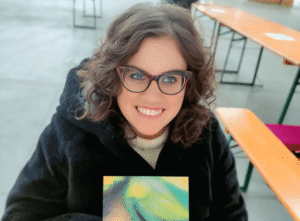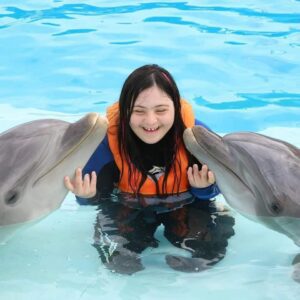


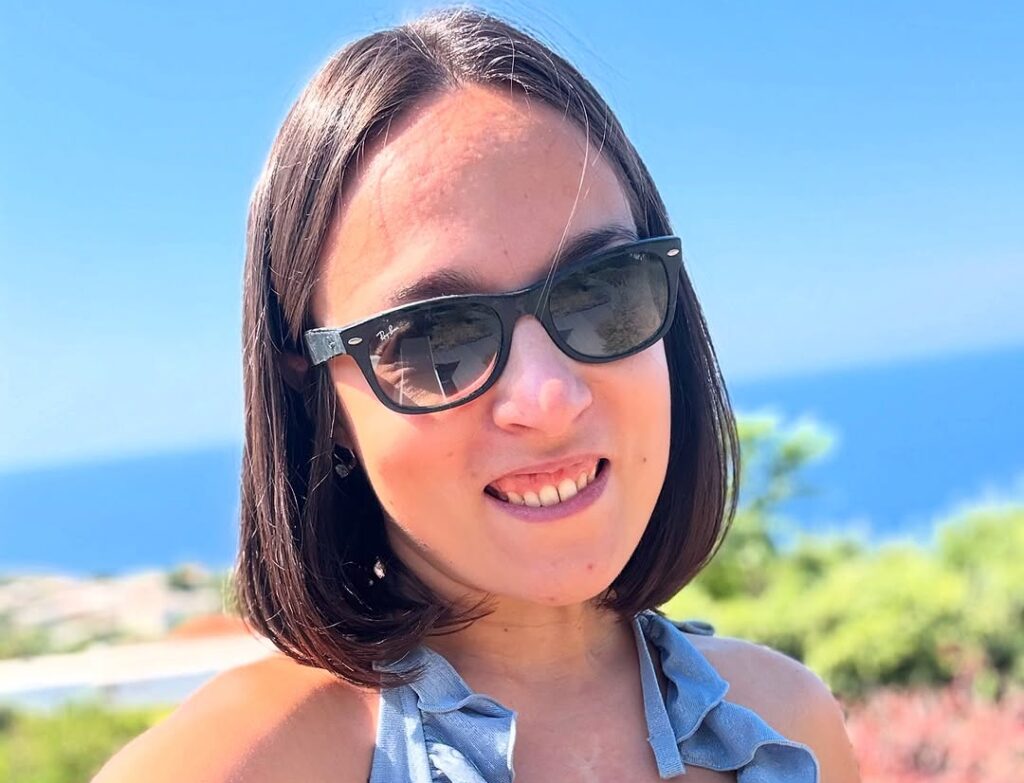
Not all scars can be seen. Some are carried inside. Others, like Maria Teresa’s, are right on the chest: a thin but powerful line that tells a 27-year-long story. A story of early diagnosis, hospitals, hardship, but above all of awareness, redemption, and self-love.
Maria Teresa was born with 22q11 chromosome deletion syndrome, also known as DiGeorge syndrome: a rare genetic condition, diagnosed just a few days after birth, when she underwent emergency heart surgery at the Bambino Gesù Hospital in Rome. That is where everything begins. “This scar is my shield,” she says today. A mark that has turned from stigma into strength, identity, and value.
A childhood “among the clouds”
Maria Teresa grew up in a loving family that always protected her. As a child, she lived in a fantasy world made of princesses and cuddles. But outside that nest, reality was harsher. School, in particular, was a difficult place.
“I was completely lost; no one understood. On the outside I seemed fine, but inside there was a world no one could see.”
Learning difficulties, isolation, and feeling “different” created invisible wounds. Deep questions. As a teenager, Maria Teresa went through dark times. For a long time she wondered if there was a place for her in the world.
“For years I asked myself: what am I living for if I’m useless?” And yet, step by step, something began to change.
Discovering her own strength
It all began with a simple question, when she was a child: “Mom, what is this on my chest?”
From that answer (“You had heart surgery when you were just a few days old”) began a journey of awareness. Years later, that scar truly began to speak to her. To tell her she was alive. That she was strong. That she was unique.
“Finally I see a glimmer of light and start to accept myself. I love who I am. I also love that scar: it is part of me”.
A vocation born from the heart
During the pandemic, Maria Teresa graduates in Legal Services Sciences. A great achievement. But not yet the right path. Then something happens. Watching the TV series Mina Settembre, a spark is lit.
The main character is a social worker. Maria Teresa understands: she wants to help others, especially the most vulnerable. She wants to become, in turn, a point of reference.
“I decided to do like her: to save people more fragile than me”.
She moves to Rome, the city where she was born, and enrolls at LUMSA University. “Here I was reborn a second time,” she says. She passes her first exam with top marks. “It was a dream. Finally I was being evaluated for who I truly am”.
Today she is studying to become a social worker, with a clear goal: to help children and young people not feel alone. Not to go through what she went through.
“I dream of helping those who feel excluded, disoriented. No one should have to suffer the way I did”.
Pride, community, and activism
Maria Teresa is not alone. She actively collaborates with Aidel22 APS, the reference association for 22q11 deletion syndrome. Together they promote information, support, and awareness. Maria Teresa also shares her story through social media and radio, with a direct and authentic style.
“Social media is not real life. I try to show the beauty of small things. We need to step away from screens”.
Her message to families is clear and powerful:
“Give your children time and space. Make them feel normal. Don’t treat them as sick: we are all different. But we all deserve to feel loved, respected, and understood”.
“Being rare is a beauty”
Maria Teresa does not define herself through illness, but through the strength with which she has learned to live. Her story reminds us how important it is to listen, to welcome, to believe in the potential of every person. A story that invites us to change our perspective and to educate toward empathy.
“Being rare is a beauty. A strength to be valued and told. Today I am proud of myself and of the scar I carry”.